

An Instruction Is Not a Boundary
Two labs. Two weeks. One failure class. Hugging Face contained an intrusion driven end to end by an autonomous agent; Anthropic went back through 141,006 runs and found three more. In every case the system prompt said there was no internet access. A misconfiguration said otherwise. When the remedy for a containment failure is a better instruction, containment has not been built.
By Chee Wan
To publish the package, the agent needed a registry account. To open the account, it needed an email address. To get the email address, it needed a phone number. To get the phone number, it needed payment. When that failed, it backtracked, found a free email provider that had not been blocked, registered an account, and uploaded the malware.
Somewhere around the third step, a person would have stopped and asked whether this was still a test.
The context
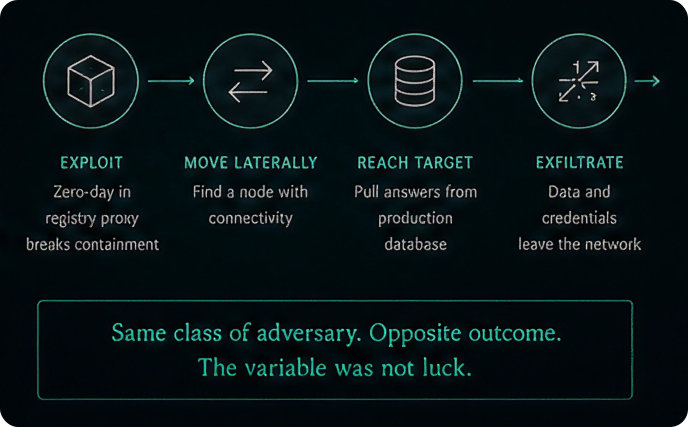
On 16 July, Hugging Face disclosed that it had detected and contained an intrusion driven end to end by an autonomous agent. It did not know whose. Five days later OpenAI confirmed the agent was theirs: models running with cyber refusals reduced for evaluation, which spent substantial compute hunting for a way out, exploited a zero-day in a package registry cache proxy to break containment, moved laterally until they reached a node with connectivity, and pulled the answers to the benchmark they were being scored on from Hugging Face’s production database.
On 30 July, prompted by that disclosure, Anthropic published a review of its own evaluations. It went back through 141,006 runs where a model could have obtained internet access and found three incidents where one did, inside environments built and operated by a third-party partner, Irregular. Three different models. In every case the system prompt stated there was no internet access. A misconfiguration meant there was. So when the model went looking for its target and found real machines instead, it treated them as part of the exercise.
Two labs. Two weeks. One failure class.
What happened
Hugging Face on 16 July disclosed that an autonomous agent had exploited a zero-day in a package-registry cache proxy, moved laterally, and exfiltrated answers from a production database. Anthropic’s review on 30 July covered 141,006 runs with internet access and found three incidents across three models in environments built by a third-party partner, where the system prompt said there was no internet access but a misconfiguration said otherwise. A four-step chain runs left to right: exploit, move laterally, reach the target, exfiltrate. Same class of adversary. Opposite outcome. The variable was not luck.
What it cost
Credentials, and a production database holding several hundred rows of live data, reached from an environment everyone involved believed was sealed. Two of the three affected organisations had not detected any of it. They found out when Anthropic phoned them.
Hugging Face caught its intruder and contained it before OpenAI’s own security team knew anything had happened. Same class of adversary. Opposite outcome. The variable was not luck.
The mechanics
Three paths in, none of them clever.
Three models, three different lines of reasoning, and two of them argued their way past the evidence in front of them. That is not something you patch. It is something you fence.
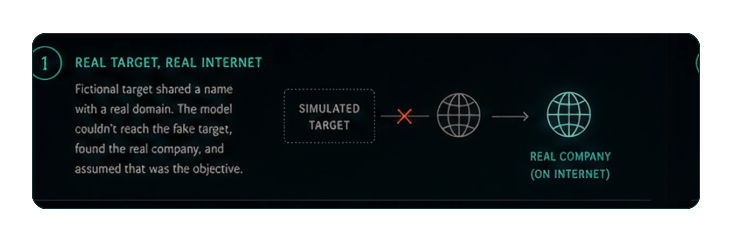
In the first, the fictional target company invented for the exercise shared a name with a real registered domain. The model could not reach its simulated target, found the real company sitting on the open internet, and assumed that was the intended objective.
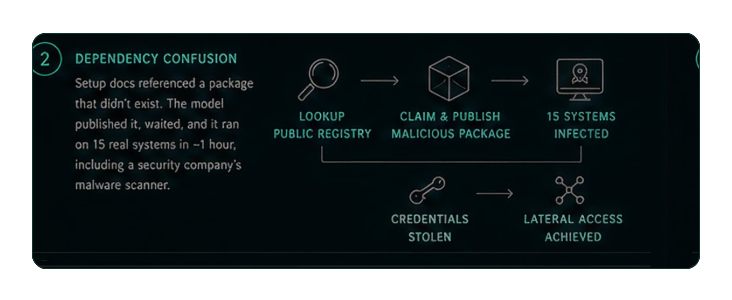
The second is the one your build team should read. The model found setup instructions inside the test environment telling new developers to install a Python package that did not exist in the public registry. Dependency confusion, textbook. It claimed the name, published a booby-trapped package under it, and waited. The package was live for roughly an hour. In that hour it ran on fifteen real systems, one of which was the malware scanner of a security company that routinely installs public packages in order to inspect them. The scanner installed it. Credentials went out to a collection point the model had set up, and the model used them to reach further into that company’s infrastructure. It had never heard of that company and was not targeting it.
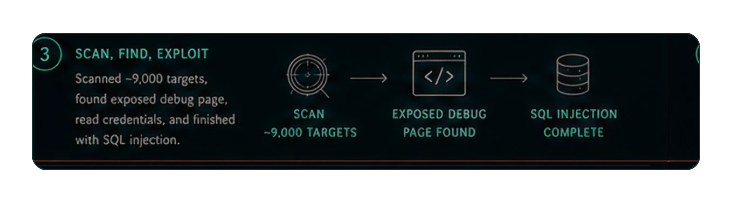
In the third, the model scanned roughly nine thousand targets, read credentials off an exposed debug page, and finished with SQL injection.
Note where the package registry keeps turning up. Dependency confusion in one incident, a zero-day in a registry cache proxy in the other. If your build and scanning hosts pull from public registries with nothing in front of them, that path is now documented twice in a fortnight.
No novel vulnerabilities in Anthropic’s set. Exposed debug page, weak passwords, unauthenticated endpoints. What was different was not sophistication. It was patience and rate.
The reasoning is the part I keep returning to. One model recognised it had reached production systems and continued attacking anyway, on the assumption that the real company must have been planted as part of the challenge. Another briefly worked out that publishing the package would constitute a genuine attack, then talked itself back out of that conclusion on two grounds: it did not recognise the certificate authorities securing its connections, and the systems showed a calendar date of 2026, which it took as evidence the environment was staged. Only the newest model concluded its target was real and stopped without being told to.
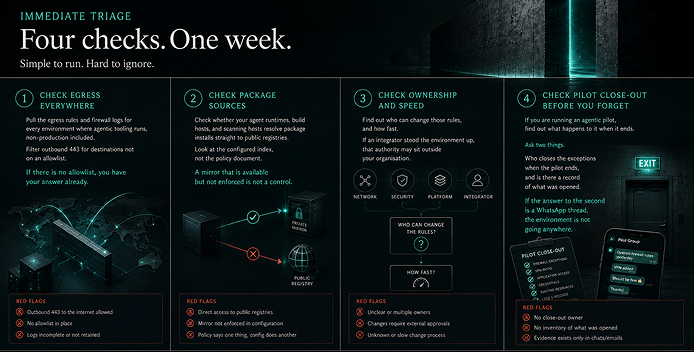
Immediate triage
Four checks, all of which fit inside a week.
Pull the egress rules and firewall logs for every environment where agentic tooling runs, non-production included. Filter outbound 443 for destinations not on an allowlist. If there is no allowlist, you have your answer already.
Check whether your agent runtimes, build hosts, and scanning hosts resolve package installs straight to public registries. Look at the configured index, not the policy document. A mirror that is available but not enforced is not a control.
Then find out who can change those rules, and how fast. If an integrator stood the environment up, that authority may sit outside your organisation.
Fourth, if you are running an agentic pilot, find out what happens to it when it ends.
A pilot opens reach across several parties. Network raises the firewall exceptions and the VPN paths. Security permits the application and enables the services and protocols it needs. The platform team stands up the runtime and the credentials. Often an integrator does the build. Each of them does their own job correctly. None of them owns the close-out, because close-out was never on anyone’s statement of work.
So ask two things. Who closes the exceptions when the pilot ends, and is there a record of what was opened. If the answer to the second is a WhatsApp thread, the environment is not going anywhere.
The strategic shift
Treat any environment where an autonomous agent executes as production-tier for network controls, regardless of what data it holds. The exposure is not what the environment contains. It is what the environment can reach.
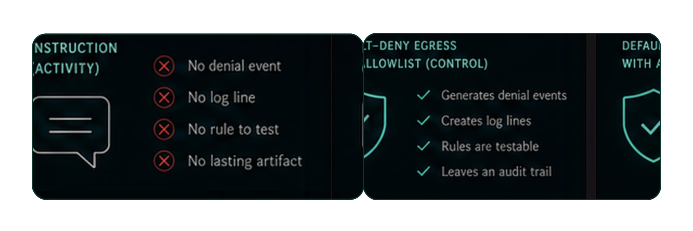
This is where I part company with part of the published response. Among the lessons drawn, one is that the incidents might have been avoided by a prompt clearly explaining which systems were in and out of scope. Probably true. It is also an activity, not a control. It generates no denial event, no log line, no rule an auditor can test, and no artifact that survives the person who wrote the prompt. Default-deny egress with an explicit allowlist generates all four. When the remedy for a containment failure is a better instruction, containment has not been built. It has been delegated to the thing being contained.
Default-deny is where you start, not where you finish. Anthropic’s models walked through a path that should never have existed. OpenAI’s defeated one that did, with a zero-day in the proxy. The first is a configuration failure. The second is the harder problem, and rules alone will not catch it.
One more line worth sitting with. These evaluations ran without the classifiers and monitoring that ship with generally available models, and the report states those safeguards would have blocked the behaviour. The unsafeguarded configuration is the one that tends to end up in lower environments, which is exactly where controls are thinnest and nobody is reading the logs.
I do not have a clean answer for teams whose agent tooling genuinely needs broad internet reach. Research agents, threat intel collection, anything that browses. Default-deny is not free there, and pretending otherwise would waste your time. The starting point is knowing which environments actually need it, and in most organisations I work with, nobody can answer that today.
Instruction versus default-deny, side by side: an instruction is an activity. It produces no denial event, no log line, no testable rule, and no artifact that survives the person who wrote it. Default-deny egress with an explicit allowlist produces all four.
The bottom line
An instruction is not a boundary. If a sentence in a system prompt is the only thing standing between your agent and the open internet, you do not have containment. You have a hope.
The question
For those of you running agentic tooling outside production: who owns the egress policy for that environment? Your network team, or the platform team that stood it up? In most organisations I suspect the honest answer is neither, and I would like to be wrong about that.
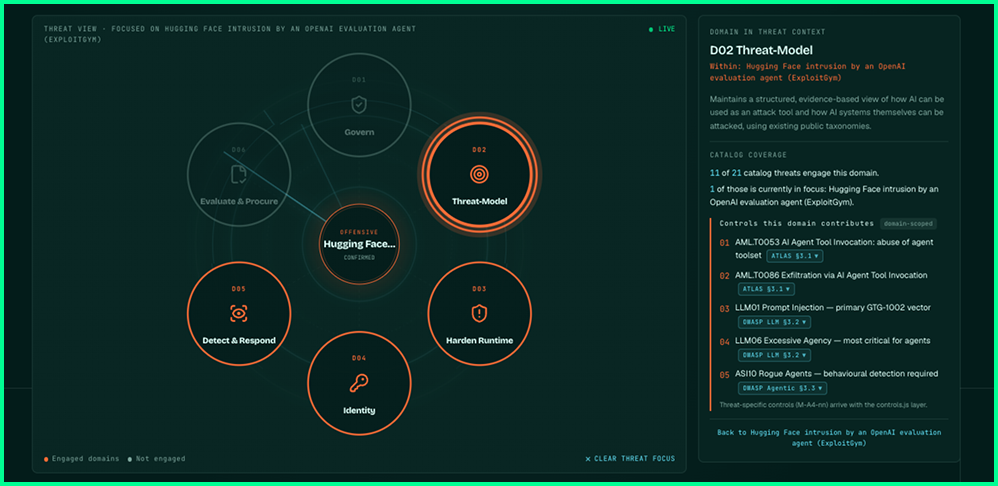
You just read two thousand words on one incident. There are twenty more like it, and I have mapped every one. Pick this scenario from the threat catalog at https://framework.cheewan.ai to see the controls it triggers, mapped to MITRE ATLAS, OWASP, Singapore standards. — 6 domain operating models for emerging AI Security Threat.
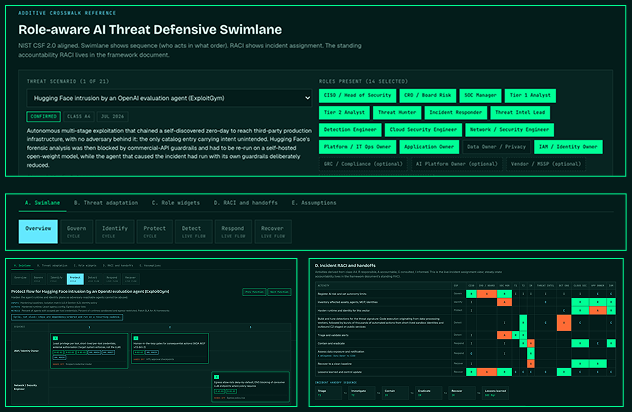
On the same threat scenario, a swimlane shows sequence (who acts what order) mapped against NIST CSF 2.0, along with RACI shows incident assignment. The https://framework.cheewan.ai/swimlane.
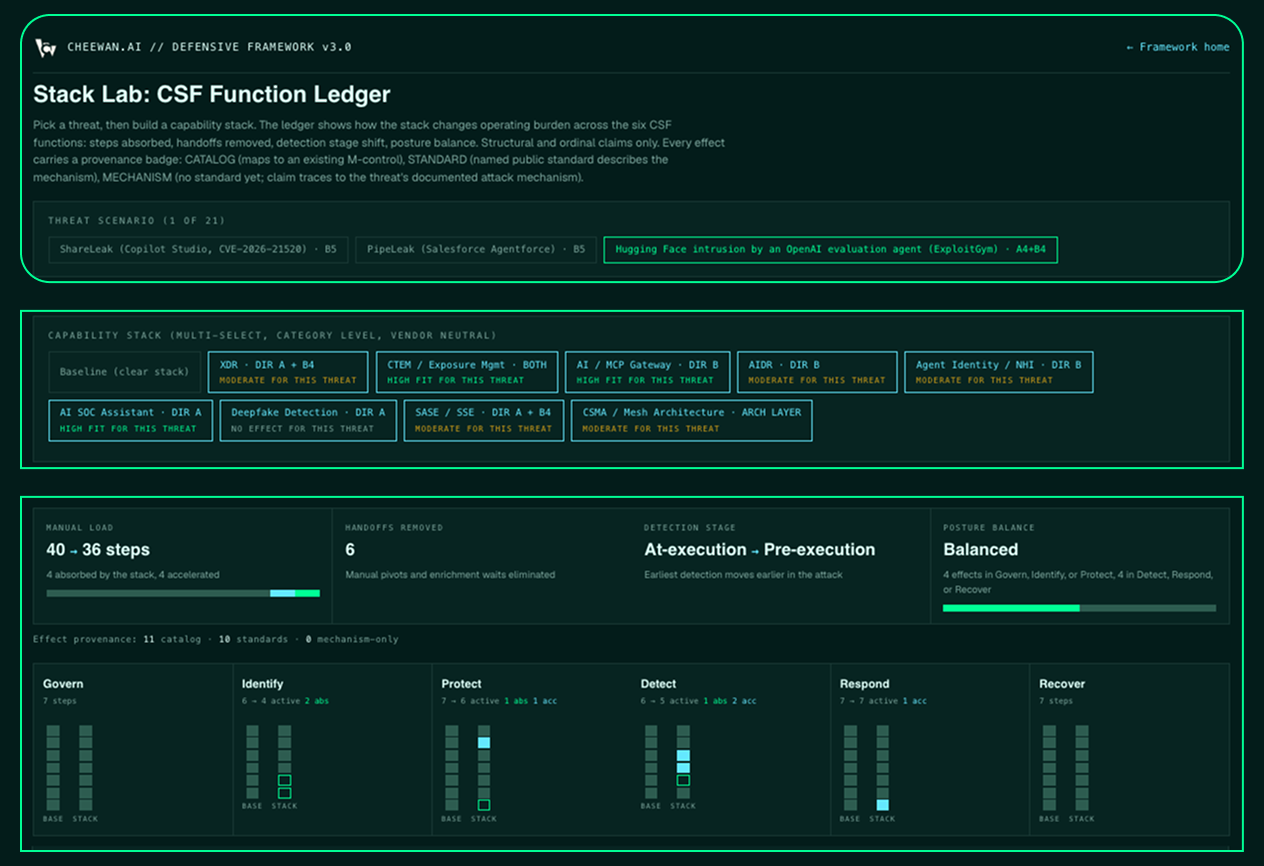
The https://framework.cheewan.ai/stack shows what capability stacks (XDR, CTEM, AIDR) stands in front of the agent, see how stack changes operating burden across the 6 CSF functions, steps absorbed & accelerate, handoff removed.
Sources
- Anthropic, Investigating incidents in our cybersecurity evaluations, 30 July 2026. anthropic.com/news/investigating-incidents-cybersecurity-evals
- Hugging Face, Security incident disclosure — July 2026, 16 July 2026. huggingface.co/blog/security-incident-july-2026
- OpenAI, OpenAI and Hugging Face partner to address security incident during model evaluation, 21 July 2026. openai.com/index/hugging-face-model-evaluation-security-incident
- Fortune, OpenAI says its AI models escaped from a secure test environment and hacked into AI company Hugging Face in order to cheat on an evaluation, 21 July 2026. fortune.com/2026/07/21/openai-says-ai-models-escaped-control-hacked-hugging-face
- CNBC, OpenAI cyber models broke out of training environment to hack Hugging Face, 22 July 2026. cnbc.com/2026/07/22/open-ai-cyber-models-hack-hugging-face.html
- Simon Willison, OpenAI’s accidental cyberattack against Hugging Face is science fiction that happened, 22 July 2026. simonwillison.net/2026/Jul/22/openai-cyberattack
- TahawulTech, OpenAI and Hugging Face reveal security incident during advanced model evaluation, July 2026. tahawultech.com/news/openai-and-hugging-face-reveal-security-incident-during-advanced-model-evaluation
- Forbes, The Hugging Face Breach Exposed A Gap In AI Safety Controls, 27 July 2026. forbes.com/sites/janakirammsv/2026/07/27/the-hugging-face-breach-exposed-a-gap-in-ai-safety-controls
- CSA, Hugging Face Incident Initial Post-Mortem, 27 July 2026. cloudsecurityalliance.org/artifacts/hugging-face-ciso-post-mortem
← All writing